
GRP Roofing ResinShop category
More info
Shop grp roofing resin for buying GRP resin, topcoat, catalyst or coating components for fibreglass roofing work. This page helps you choose…
Shop grp roofing resin for buying GRP resin, topcoat, catalyst or coating components for fibreglass roofing work. This page helps you choose…
Shop grp roofing topcoat for buying GRP resin, topcoat, catalyst or coating components for fibreglass roofing work. This page helps you choose…
Shop resiroof grp roofing system for preparing, installing, finishing or maintaining a GRP fibreglass flat roof system. This page helps you choose…
Shop fire rated grp resin & topcoat for preparing, installing, finishing or maintaining a GRP fibreglass flat roof system. This page helps…
Shop standard grp resin & topcoat for preparing, installing, finishing or maintaining a GRP fibreglass flat roof system. This page helps you…
Shop grp activators & catalyst for buying GRP resin, topcoat, catalyst or coating components for fibreglass roofing work. This page helps you…
Showing 1–16 of 27 resultsSorted by price: low to high


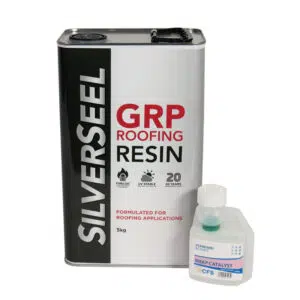


Shop GRP roofing resin, fibreglass roof topcoat and catalyst hardener separately for top-ups, repairs, custom material lists and component replacements. Resin wets out the chopped strand mat to form the laminate. Topcoat goes over the cured laminate as the final weatherproof finish. Catalyst activates both.
GRP roofing is a two-stage liquid system. Stage one is the laminate — roofing resin is mixed with catalyst and applied to the primed OSB3 deck, then the fibreglass matting is laid into the wet resin and rolled out to remove air bubbles and fully saturate the mat. Once the laminate has cured to a firm but not fully hard stage, stage two begins: the topcoat is mixed with catalyst and applied over the laminate surface. Topcoat seals the mat fibres, provides the UV-stable weatherproof surface and gives the roof its finished colour and sheen.
Catalyst percentage controls how quickly the resin or topcoat cures. Too little and the material stays tacky or does not cure at all. Too much and it cures so fast that the working time is insufficient to wet out the mat properly. Standard guidance for UK summer conditions is typically 2% catalyst by volume. Below 10°C, the percentage needs to increase and curing still takes significantly longer. Winter catalyst formulations are available for cold-weather work.
Roofing resin is used to wet out the fibreglass matting and create the laminate layer bonded to the deck. Topcoat is applied over the cured laminate as the final surface coat — it is UV-resistant and forms the weatherproof finish. They are different products used at different stages.
Yes. Catalyst must be added to both the roofing resin and the topcoat immediately before use. Without catalyst, neither product will cure.
Standard guidance is around 2% catalyst by volume in typical UK summer temperatures. In cold conditions below 10°C, the percentage needs to increase and curing still takes longer. Always follow the product-specific guidance rather than estimating.
Yes. Topcoat, resin and catalyst are sold separately here. Topcoat can be bought alone for refreshing a weathered GRP surface or applying over an already-laminated area that only needs a topcoat repair.
Match the matting weight to the GRP kit specification — 300g for lighter domestic roofs, 450g for standard garages and extensions, 600g for heavier-duty applications. The resin weight coverage per square metre varies by matting weight.